
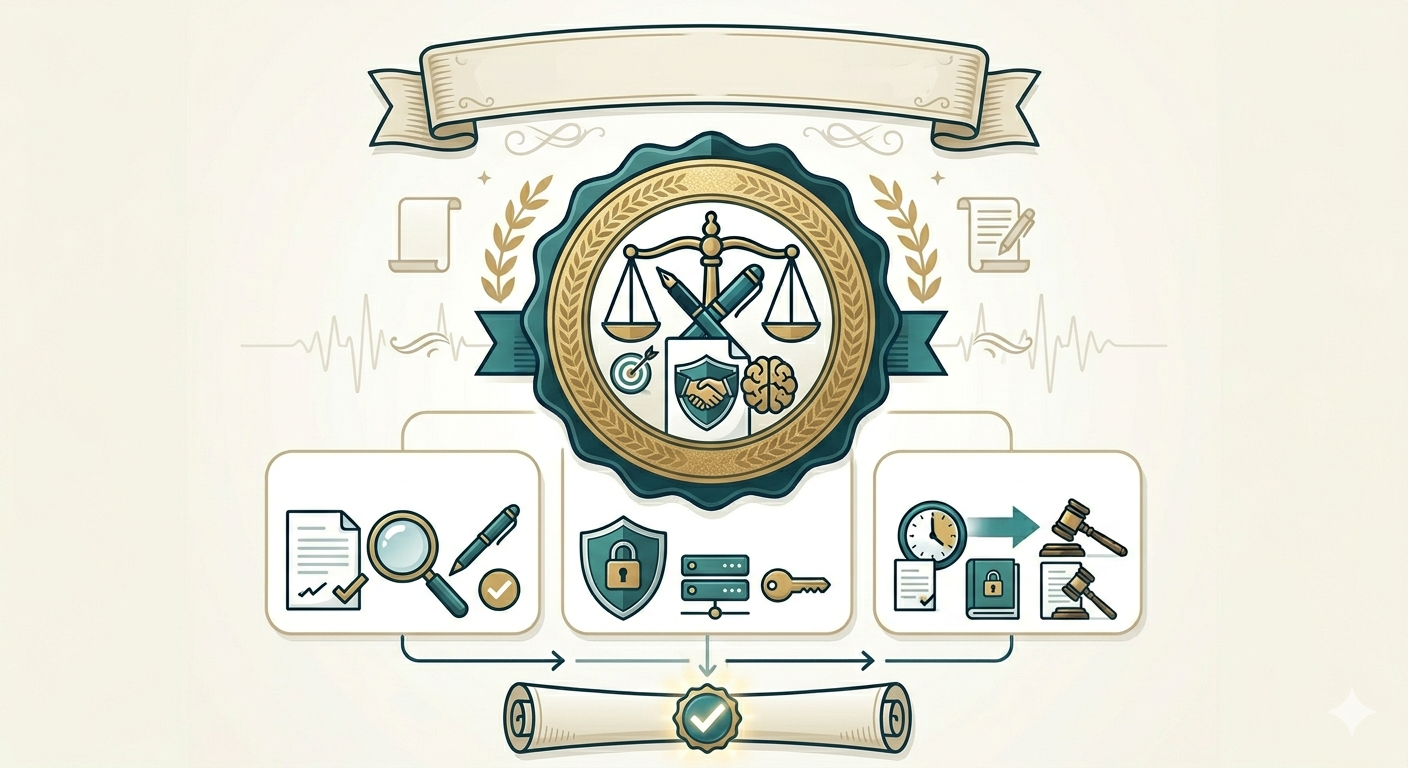
In the modern legal environment, accuracy is no longer a feature but the foundation. The digitization of court procedures is increasing the demand for reliable and scalable transcription solutions. Simultaneously, the market continues to change. Many platforms have emerged by combining existing tools. This is often driven by industry consolidation rather than purpose-built innovation.
This brings up an important question for legal practitioners: what makes a court transcription platform reliable?
For us at DepoDash, this transformation has been very positive. We believe a reliable transcription service should create transcripts and ensure high accuracy. It should also provide smooth processes and be designed specifically for legal use.
What Are Court Transcription Services Today
Court transcription services turn audio recordings of legal proceedings and depositions into accurate written transcripts. They use digital platforms and advanced technology to ensure precision.
Court transcription services have evolved significantly; nowadays, it is not just a manual process. These programs now blend automation, smart workflows, and AI features. They tackle complex legal audio efficiently. Due to this change, law firms are able to deal with transcription on a large scale, with the same time and consistency.
Why Reliability Matters More Than Ever In Legal Transcription
Even small transcription errors can cause significant problems in the law. A wrongly understood statement or an omitted detail can change the result of a case, make the court process slower, or lead to compliance risks.
Trustworthy transcription services have to offer:
- Performing accurately under various audio conditions
- Keep format and terminology consistent
- Safeguard security for confidential legal data
- Capacity to meet the demand increase
If you do not have these features, transcription may even appear as your weak point rather than your strong point.
The Hidden Problem With Many Court Transcription Platforms
Not all platforms are created equal. A common issue in the market is the reliance on systems that are assembled from multiple third-party tools.
While this approach may accelerate development, it often introduces:
- Integration challenges
- Inconsistent transcription outputs
- Fragmented user experiences
- Limited control over accuracy
Platforms built this way often struggle with reliability. This is especially true as usage grows or complexity rises.
Built Not Bought: Why Platform Architecture Matters
A major pillar of choosing a transcription platform that does not get much attention is the manner in which it is coded.
Some key benefits that a platform entirely developed from scratch can offer include:
- Integrated workflows free from dependency issues
- Enhanced capability for accuracy and processing
- Reliable output in every application
- The most natural user interface possible
We at DepoDash follow a “built, not bought” approach. Our platform is custom-built from scratch. Legal professionals designed it, knowing the challenges of transcription in their field. This is why we can focus on what really matters – accuracy, trustworthiness, and user-friendliness.
Unlike platforms assembled through acquisitions or integrations, a purpose-built system offers consistency that cannot be replicated through stitched solutions
What To Look For In A Court Transcription Platform
Simply comparing features is not enough when choosing a transcription partner. It also means looking at how well a platform fits into legal workflows and meets accuracy standards.
Accuracy Across Complex Legal Audio
It is not uncommon for legal recordings to have multiple people speaking at the same time, the use of technical terms, and different accents. A reliable service must handle these challenges and still deliver accurate results.
Audio File Transcription Capabilities
In the last few years, real-time transcription has attracted more and more attention. However, a great portion of legal workflows still depend on recorded audio. Besides that, audio-based transcription supports deeper processing, review, and refinement.
In our experience at DepoDash, the audio transcription platform consistently delivers higher accuracy, especially in complex legal scenarios.
Real Time vs Audio Transcription Tradeoffs
With real-time transcription, you get immediacy. It might come in handy in certain situations. But usually, it is difficult to get accurate results because of the live conditions.
On the other hand, audio transcription has these advantages:
- Greater accuracy
- The ability to review and refine outputs
- More reliable handling of challenging audio
Platform Stability And Workflow Integration
A trustworthy platform must offer smooth, integrated functionality from start to finish. It shouldn’t just be a mix of separate tools. This not only guarantees efficient workflows but also minimizes errors.
Security And Compliance Standards
Legal data is highly sensitive and therefore must be protected rigorously. Look for software that treats information security and compliance as key parts of its design.
Designed By Legal Professionals
Platforms built with legal expertise can tackle real legal issues better. They are designed with a clear grasp of legal processes, and the expectations of the legal field.
Real Time Transcription: Where It Fits And Where It Falls Short
Real-time captioning is very helpful today. It supports legal work by providing immediate text for eye witness statements in court.
Yet, one should bear in mind the following disadvantages:
- Accuracy is highly likely to be compromised if there is background noise or overlapping speech.
- Reviewing or fixing errors would be a major limitation.
- More chances of inconsistencies in difficult or complicated situations.
For this reason, many legal teams use real-time transcription as a supplementary tool while relying on audio transcription for official records
Why Audio Transcription Remains The Gold Standard For Accuracy
Transcription of audio is still the gold standard for accuracy in the legal sector. Real-time technology has improved a lot, but it hasn’t replaced transcription.
Main benefits are:
- Capability to revisit and improve transcripts
- Enhanced processing of very challenging audio environments
- More uniform results in different situations
We at DepoDash have been delivering results beyond our competitors in this area. Our platform is built for precise audio transcription. This helps legal teams trust and rely on the transcripts.
How To Choose The Right Court Transcription Partner
Choosing a transcription platform is a strategic move. To guarantee a lasting commitment, here are a few things you should keep in mind:
- Is the platform completely original or an integration of various tools?
- Does it sacrifice speed to provide accuracy?
- Is it a legal software tool at its core?
- Can it increase scale while still maintaining high performance?
- Does it deliver reliable results across various use cases?
By concentrating on these aspects, you make sure that the platform you pick will be able to meet your present requirements and grow with you.
The Future Of Court Transcription Services
AI and SaaS platforms are shaping the future of court transcription. Mergers and acquisitions are reshaping how these platforms are made and offered.
Looking ahead, the solutions that will work best in the long run are those that:
- They are fully integrated instead of pieced together.
- Mix domain expertise with automation.
- Make accuracy a main point, not something that is overlooked.
At DepoDash, we believe the future of our platform is for those designed with legal workflows in mind. It should be reliable from the start.
To Conclude
There is not one single feature of reliability that may define court transcription. The reliability of court transcription comes from smart platform design, a deep understanding of legal needs, and a constant focus on accuracy.
With the constant changes in legal processes and workflows, it is crucial to decide on a suitable transcription platform. A good tool does more than create a transcript. It helps improve results, reduces risk, and makes work more efficient.
If you’re exploring court transcription platforms for legal use, consider DepoDash. You can also reach out to our team to learn how we can provide you with a reliable and accurate workflow.
FAQs
What are court transcription services?
Court transcription services turn legal audio, like depositions and hearings, into written transcripts. They use digital platforms and advanced processing tech to do this.
How accurate are court transcription platforms?
Accuracy depends on the platform and transcription method used. Platforms optimized for audio transcription typically deliver higher accuracy because recordings can be reviewed, refined, and reprocessed.
Is real-time transcription reliable for legal work?
Live transcription offers quick text access, but it often lacks the accuracy needed for official records. A good number of legal experts turn to audio transcription, which, generally, offers better reliability.
Why is audio transcription more accurate than real-time?
Transcribing audio helps fix errors. This leads to better management of tough audio conditions and more accurate transcripts.
What should I look for in a transcription platform?
Imagine a platform built from scratch. It prioritizes accuracy and fits seamlessly into current workflows. It’s specifically designed for the legal sector.