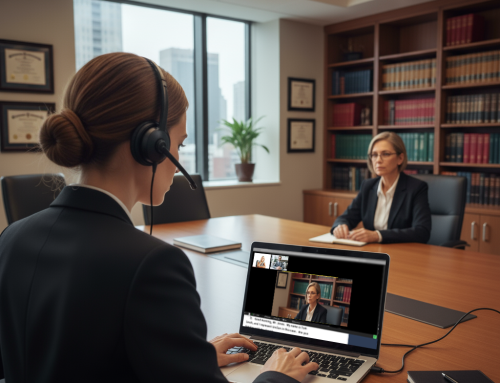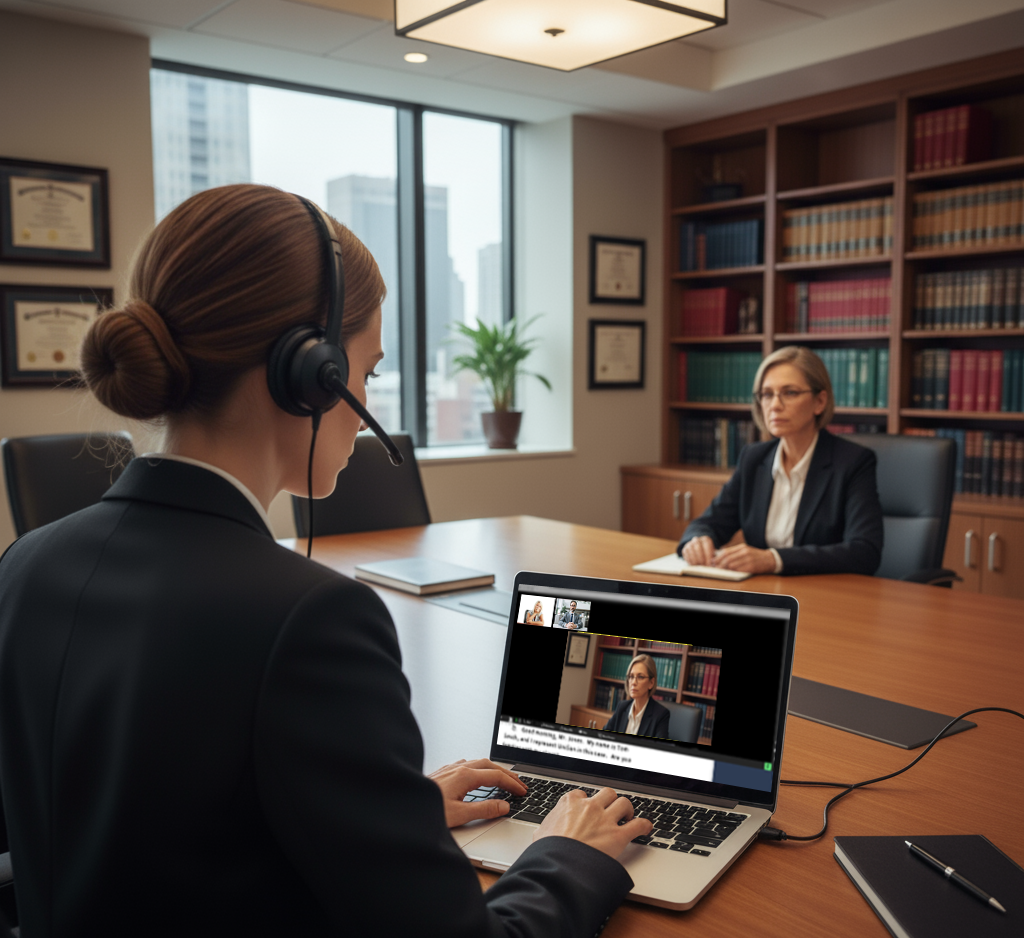
Transcription today is no longer just about converting speech into text. It is about providing error-free, uniform, and dependable work in large quantities. With the adoption of digital legal operations, software to transcribe with the help of AI is becoming a key element.
Nevertheless, various AI transcription programs have different levels of quality and features.
Many platforms now come from stitched integrations or acquired tech. Legal professionals must ask: what makes AI transcription reliable for legal audio files?
At DepoDash, we approach this from a practical perspective. Reliability isn’t just about automation. It’s about how a platform works in real legal situations. In these cases, clarity, precision, and context are key.
What Is AI-Powered Transcription Software
AI-powered transcription software relies on sophisticated mathematical models to transform speech into text. These systems quickly process audio data. They identify speech breaks, different terms, and the overall speech structure.
In the area of law, it is more than an ordinary transcript. It is a process that requires:
- Deciphering intricate jargon
- Identifying different speakers at the same time
- Capability to work with diverse audio quality
- Producing well-organized, understandable transcripts
Currently, some platforms mix AI and automation of workflows to be a great ally to legal teams, ensuring transcription is done more efficiently.
Why Reliability Matters In Legal Audio Transcription
Legal transcription doesn’t fall under a very common use case. It works in a high-risk environment where even slight inaccuracies can lead to very serious consequences. A trustworthy transcription program has to guarantee:
- Accurate use of words and correct terms
- Continuous features in different files
- Understandable dialogues with several speakers
- Safe processing of confidential information
If not reliable, transcription is a liability instead of an asset.
The Challenge With Many AI Transcription Platforms
The AI transcription market is growing. Many portals now offer similar features instead of introducing new ones. Although development can be accelerated through this strategy, it will likely lead to:
- Varying quality of transcription
- Lack of sufficient control over the processing
- Disjointed or interrupted workflows
- Elusive reliable scaling capability
Based on our observations, we think any of these deficiencies will be laid bare in a legal use case. In that setting, it’s imperative to have both accuracy and consistency.
Built Not Bought: Why Architecture Defines Reliability
The design of a transcription platform significantly determines how dependable it is. A specially designed platform provides:
- Streamlined workflows within the system
- More control over the transcription operations
- Reliable output in various scenarios
- A network of users that is more steady and engaging
At DepoDash, we adopt a grassroots approach to developing our platform. Our legal professionals, who witnessed the details of legal transcription, created it. That is how we manage to concentrate on providing you with dependable outcomes at the points that really count.
A system built from scratch provides a level of consistency that’s hard to achieve with platforms made from multiple acquisitions or integrations.
What Makes AI Transcription Reliable For Legal Audio Files
There are several key factors that determine reliability in AI transcription.
Accuracy Across Complex Legal Audio
Legal recordings often involve:
- Overlapping dialogue
- Technical language
- Varied accents and speaking styles
A reliable AI system must process these complexities without losing context or clarity.
Ability To Process Recorded Audio Effectively
Audio recordings are still a primary element in legal operations. It enables:
- More thorough handling
- Second, listening to the ambiguous parts.
- Greater precision by successive improvements
At DepoDash, we’ve found that well-processed audio files lead to better and more reliable transcripts.
Consistency Across Cases And Workflows
Legal professionals need standardization. A trustworthy platform should deliver the same quality of output irrespective of the case or audio environment.
Workflow Integration And Platform Stability
- Reliability goes beyond transcription quality. It also includes how well the platform fits into current workflows.
- A unified system reduces errors, boosts productivity, and creates a more seamless and reliable experience.
Security And Compliance
Legal audio recordings involve confidentiality. A reliable transcription platform must focus on data protection and meeting regulations. These are key parts of its design.
Designed With Legal Expertise
Systems created with legal professionals are better at handling real-world challenges. They showcase a better grasp of legal lingo, context, and the level of quality one can expect.
How AI Transcription Supports Modern Legal Workflows
AI-powered transcription is transforming how legal teams handle documentation. Key benefits include:
- Faster turnaround times
- Improved scalability
- Reduced manual effort
- Better accessibility to case information
At the same time, reliability ensures that these benefits do not come at the cost of accuracy.
The Role Of Audio and Real-Time Transcription In Legal Work
Audio transcription and real-time transcription are both useful for legal tasks today.
The benefits of real-time transcription include:
- Instant availability of spoken words
- Assistance in live situations
- Increased teamwork
Both real-time transcription and audio transcription play essential roles in modern legal workflows. Real-time transcription provides immediate visibility into proceedings, enabling faster collaboration and decision-making during live events.
Audio transcription, on the other hand, allows for deeper processing and refinement, supporting highly accurate and dependable final records. Rather than competing, these approaches work best together as part of a complete transcription strategy.
Why Audio Transcription Remains Critical For Accuracy
Recorded audio remains crucial for high accuracy in legal transcription, even with advances in real-time technology. The main advantages are:
- You can go back and polish the transcripts, for example.
- If the audio is complicated or unclear, it can be dealt with more easily.
- You will get more reliable outputs under varying conditions.
This fact is important in the legal world. Transcripts are usually the official documents.
What To Look for in AI-Powered Transcription Software
Assessing transcription software requires you to examine more than just the basic features that are visible at first glance. Here are some aspects you should consider:
- Firstly, is the platform a purpose-built one or a combination of multiple tools?
- Secondly, does it mainly focus on accuracy in actual legal situations?
- Thirdly, is it capable of regularly handling complicated audio?
- Fourthly, can it be smoothly integrated into your work process?
- Fifthly, is it created exclusively for legal purposes?
Choosing the right platform gives you lasting reliability and boosts productivity.
These factors closely align with what defines truly reliable court transcription platforms in today’s legal environment.
The Future Of AI Transcription In Legal Services
As technology grows and legal workflows go digital, AI transcription will keep improving. The best platforms will be those that:
- Mix automation with deep knowledge.
- Provide the full suite of solutions in one package.
- Ensure that accuracy and reliability are always kept as a strong focus.
DepoDash believes the future is for platforms that help legal professionals. These platforms should manage real-time and audio transcription with ease.
Key Takeaway
Reliability in AI transcription isn’t just about the technology. It’s also about how it’s used in legal settings. To be reliable, a platform must first offer regular, high accuracy. It should fit into existing workflows without causing problems and, most importantly, be developed with legal issues in mind.
If you are evaluating AI-powered transcription solutions for legal workflows, exploring a purpose-built platform like DepoDash can help you better understand what reliable transcription looks like in practice.
FAQs
What is AI-powered transcription software?
AI transcription software turns speech into text using powerful algorithms. These systems recognize speech and automatically translate it into written words.
How accurate is AI transcription for legal audio?
The answer lies in the choice of the transcription platform and the level of audio quality. Software packages that are aimed at legal users and offer a high degree of audio processing usually produce better results.
Can AI transcription handle complex legal recordings?
The latest platforms can handle multiple speakers, legal terms, and various audio qualities accurately.
Is AI transcription better than real-time transcription?
They are complementary. Live transcription provides instant access, while recorded audio transcription allows for in-depth analysis. You can refine the output further.
What should I look for in AI transcription software?
Select a technology that is accurate and secure. It should meet legal needs, offer excellent audio transcription, and be easy to use.